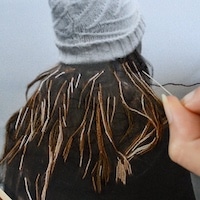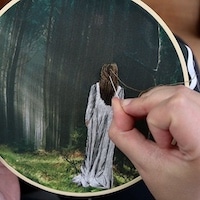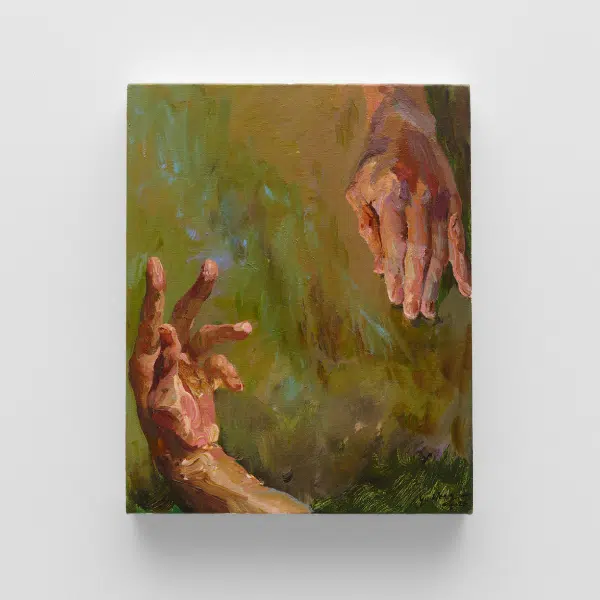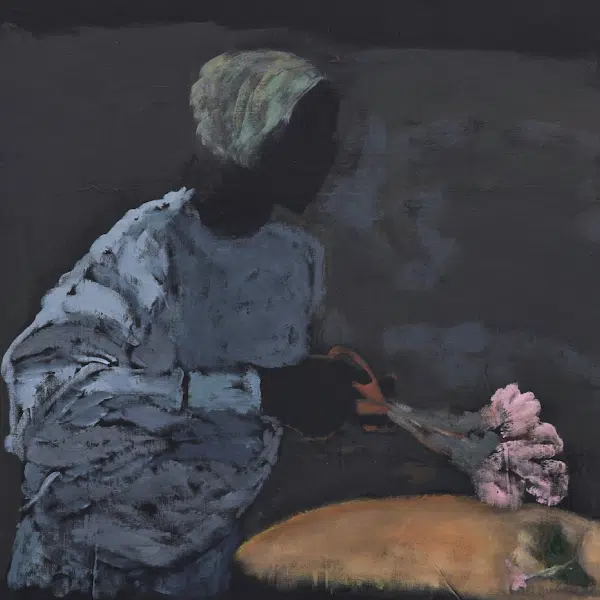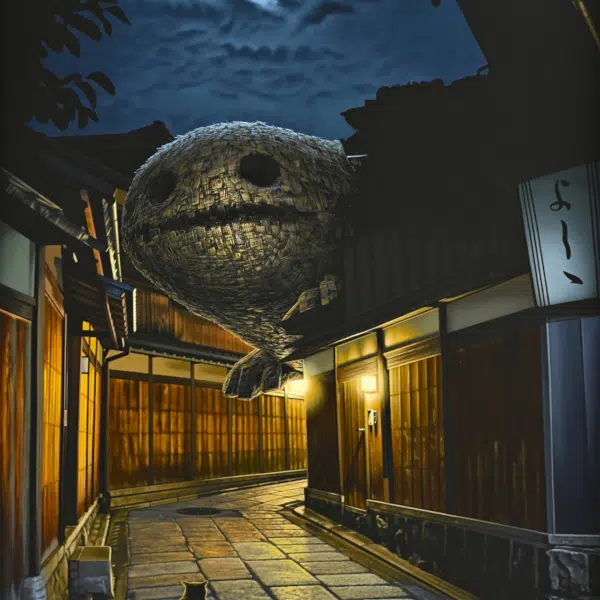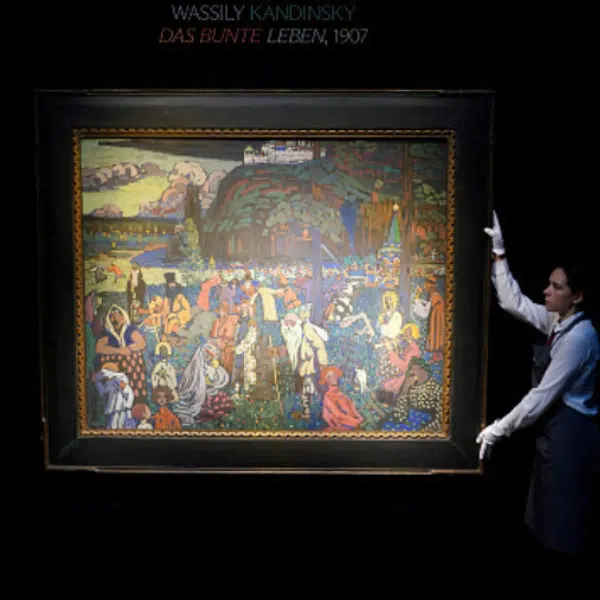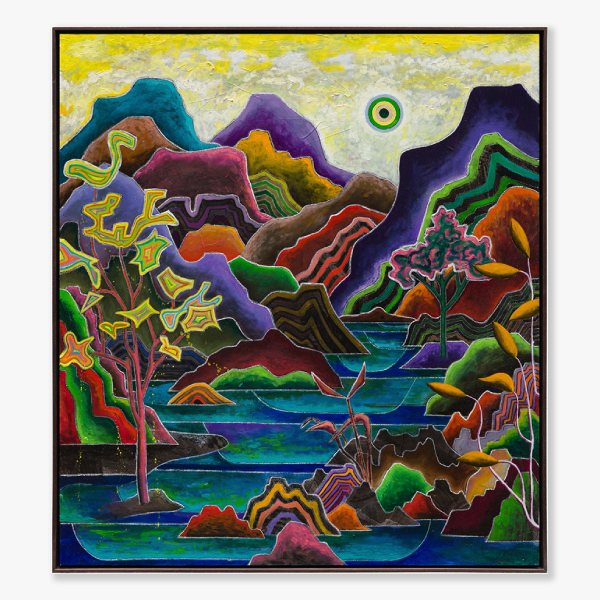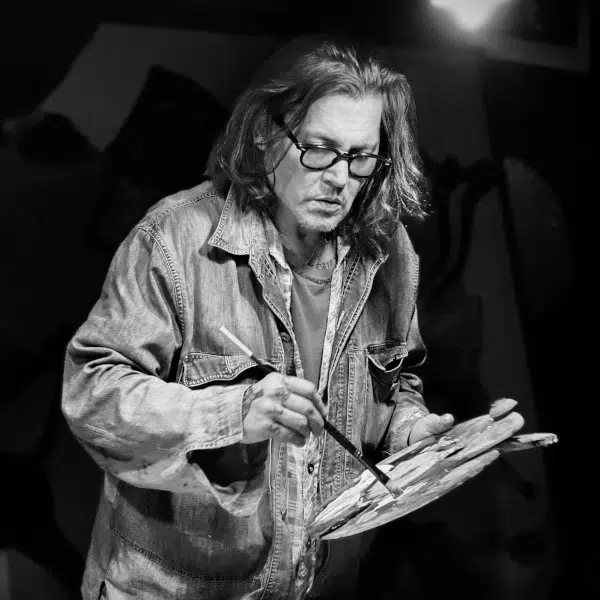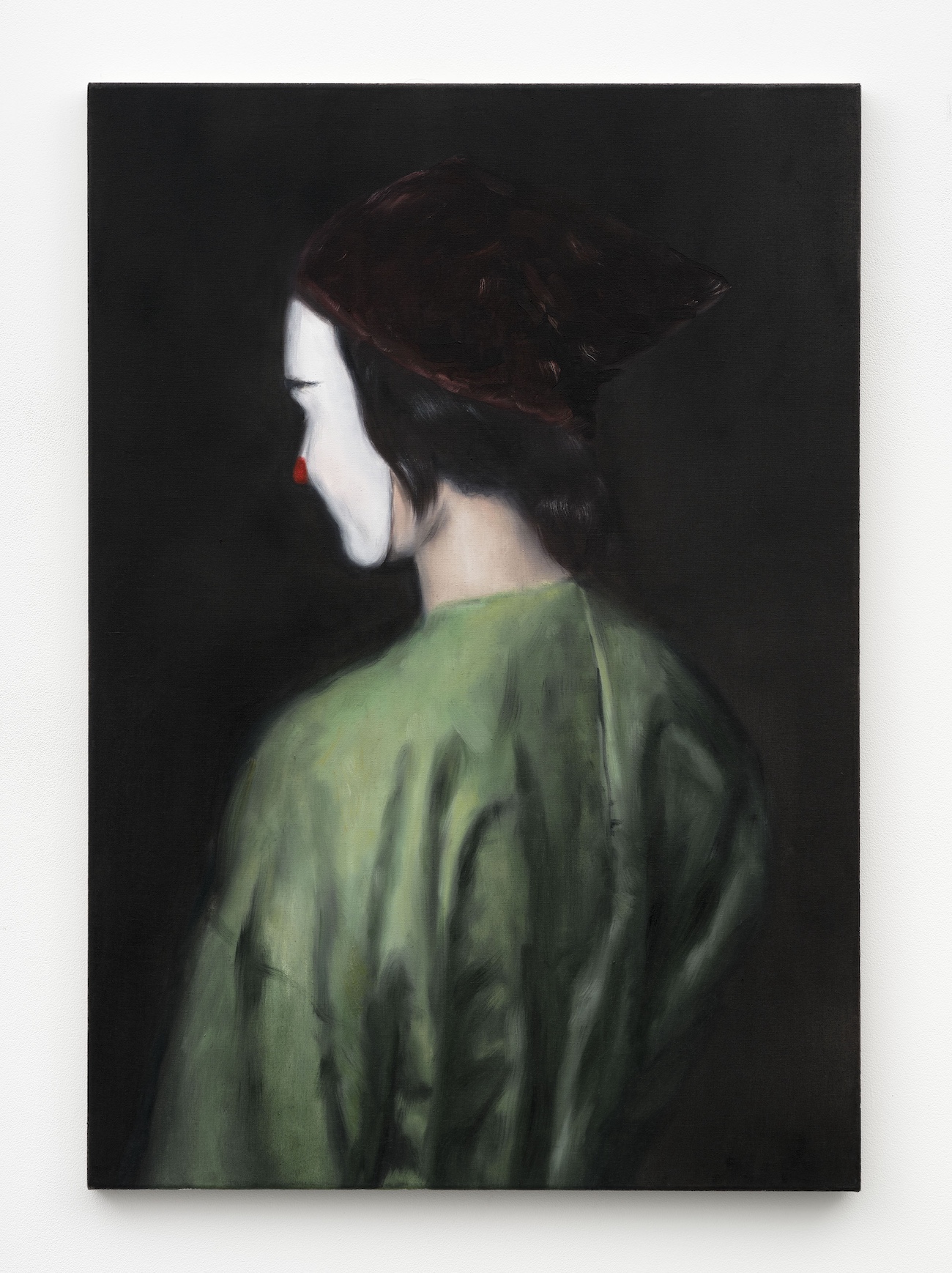
Mia Middleton, “Turning (Outside the World),” 2026. (Photo: Paul Salveson, courtesy of the artist and Roberts Projects, Los Angeles)
At first glance, Mia Middleton’s paintings can feel like fragments of a story you’ve entered halfway through. A figure turns away from view, a face is covered, or a familiar gesture suddenly feels strange when separated from its original context. Rather than filling in the missing pieces, the artist deliberately leaves room for uncertainty, allowing viewers to decide for themselves what might be happening.
Born in London, from Northland, New Zealand, and now based in Lisbon, Middleton has built a practice around these kinds of ambiguous moments. Her paintings often isolate gestures, figures, and objects, turning seemingly ordinary scenes into images that feel psychological, surreal, and slightly unsettling.
That sense of mystery ran throughout Summoning Cleo, Middleton’s second solo exhibition with Roberts Projects, which was on view from September 19 through October 24, 2026. The new body of work brought together intimate paintings with larger-scale works, many inspired by anonymous vintage photographs she discovered in markets. Middleton was drawn to these images precisely because so much about them has been lost. Removed from their original histories, the people and gestures become open-ended material that she could reshape into scenes that feel both familiar and strange.
The exhibition also marked a more personal turn for the artist. Middleton described Summoning Cleo as a kind of reckoning with themes that have long appeared in her work, including loss, ambiguity, and psychological imbalance. At the center of it all was Cleo, a figure who was never actually shown. Instead, she represented what Middleton calls her “fantasy of a certain future,” an imagined possibility that remained just out of reach.
My Modern Met had the chance to speak with Middleton about the anonymous photographs that inspired her, why she prefers to leave her paintings unresolved, how working at a larger scale has changed her process, and the mysterious figure at the heart of Summoning Cleo. Read on for an exclusive interview with the artist, which was conducted before the show ended.
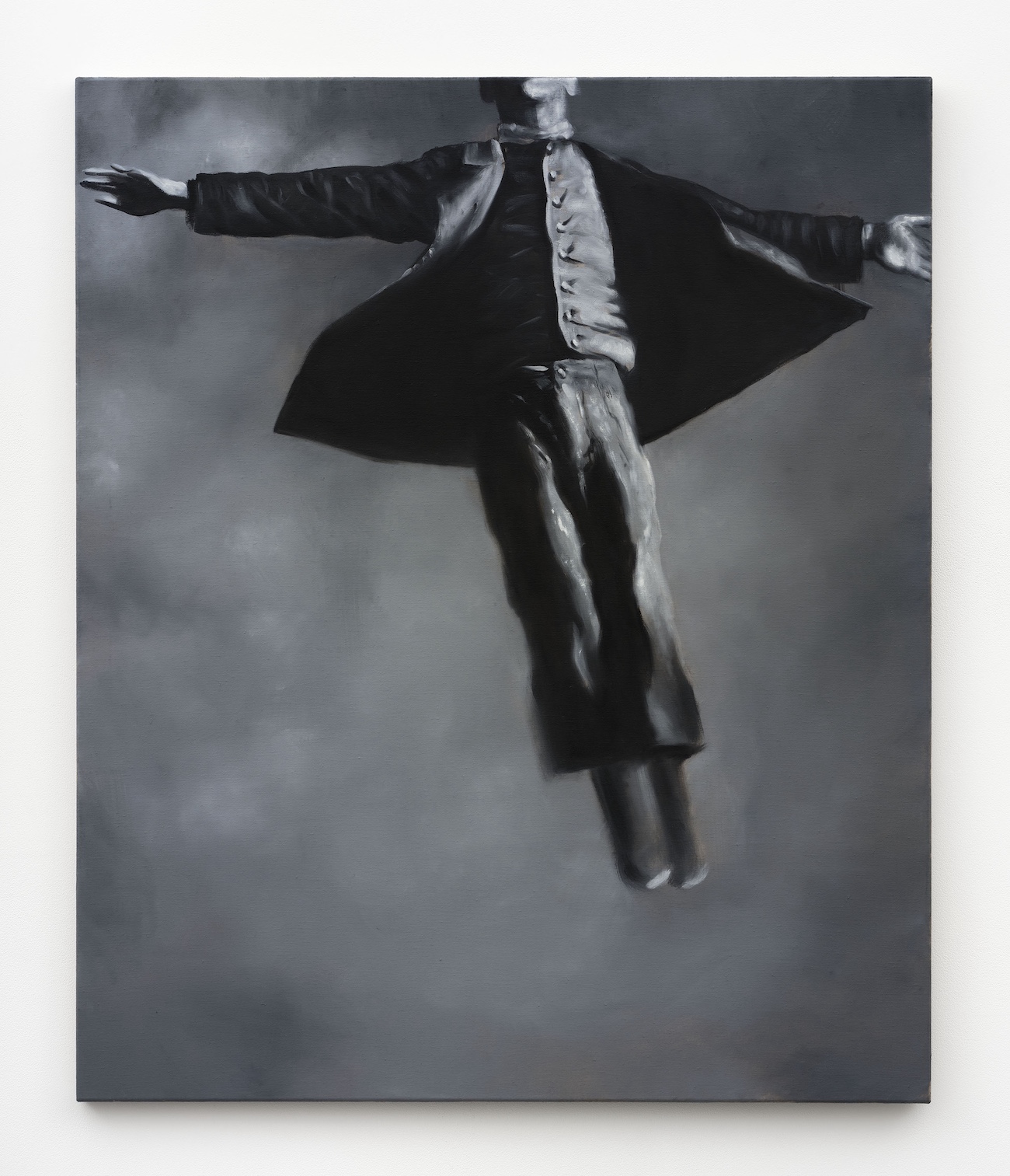
Mia Middleton, “Invocation,” 2026. (Photo: Paul Salveson, courtesy of the artist and Roberts Projects, Los Angeles)
Your paintings often capture moments that feel familiar but also slightly unsettling or difficult to place. What first drew you to these kinds of ambiguous scenes, and what keeps you returning to them?
They are the images that populate my mind really, a sort of stilted array of gestures and scenes that conflate introspection and distortion through a somber, fantastical lens. They just continually emerge in my mind and excite me, and I think it’s because the quotidien behaviors and customs we enact each day can feel very stiff, tired, and inherited from systems we don’t relate to. So I like to upend that.
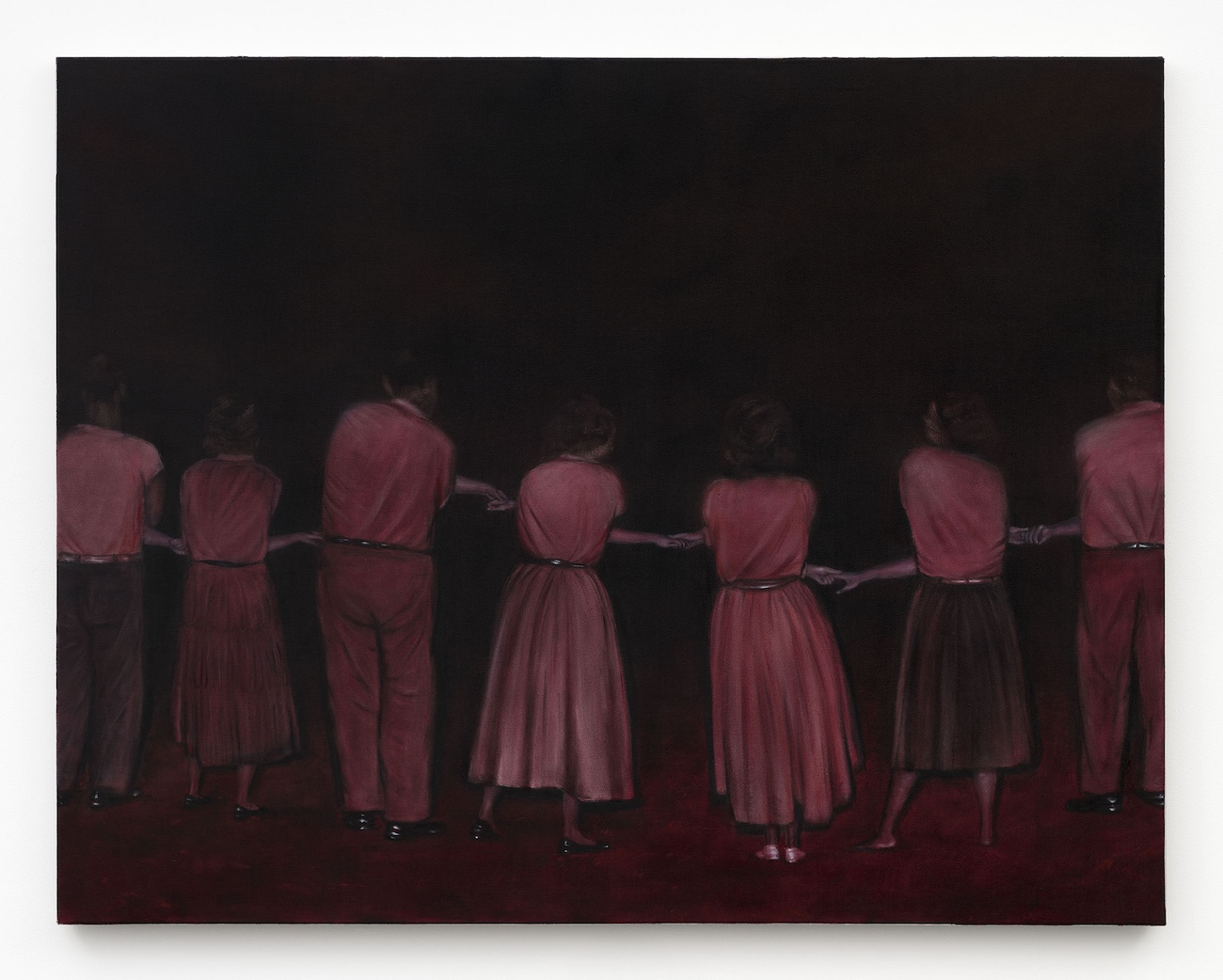
Mia Middleton, “Summoning Cleo,” 2026. (Photo: Paul Salveson, courtesy of the artist and Roberts Projects, Los Angeles)
How does Summoning Cleo build on your earlier work? Was there something you wanted to push further or approach differently with this exhibition?
Summoning Cleo is a crystallization of many of my usual themes; loss, ambiguity, psychological imbalance. This time it’s a little more personal than usual, each image really represents a step on a path of personal reckoning. I think starting each work from such a deeply intimate place was new to me, as was the slightly expanded scale. My practice started small, and I engaged in world-building through seriality and image associations, but as I progress, I’m increasingly combining archive imagery with my own drawings into more complex, novel scenes. It’s exciting territory for me.
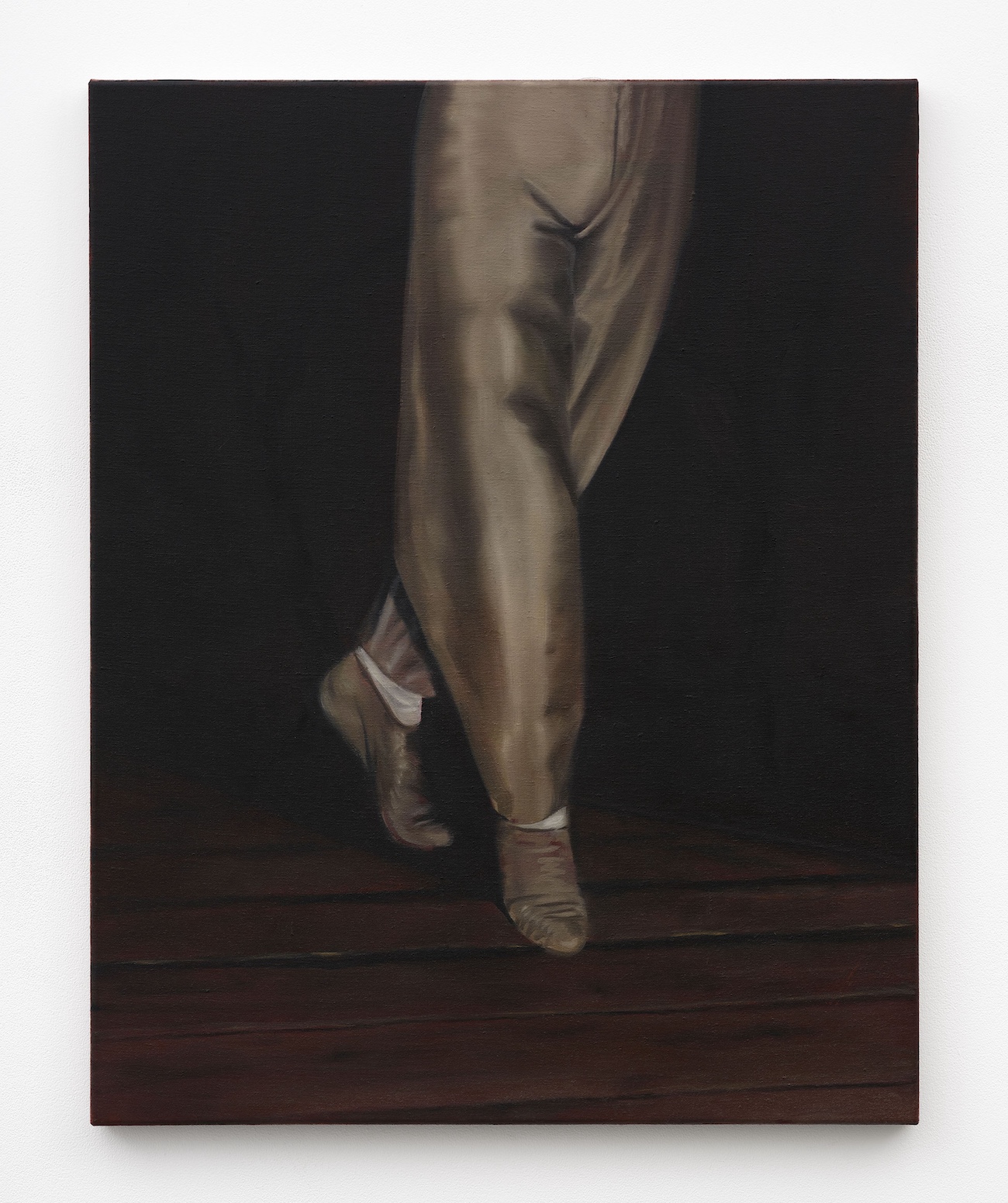
Mia Middleton, “A Concentrated Body,” 2026. (Photo: Paul Salveson, courtesy of the artist and Roberts Projects, Los Angeles)
You often work from anonymous vintage photographs that you find in markets. What makes you stop at a particular image, especially when you know very little about the people or circumstances behind it?
There’s something in the act of selection that mimics the ineffability I’m trying to circle in my work at large. It’s impossible to say why an image jumps out at me, but it’s valid to assume that they speak to my psyche in a way that teases out whatever thematic obsession I’m embodying at that time. I do use my own subconscious as a starting point, and expand into the global from there. These images are doing both. They’re alienated by their anonymity and distance across history, and simultaneously deeply intimate as traces of a personal moment that has survived across time. To bring them into my life and work is not a frivolous undertaking, it’s an act of caretaking and of haunting. For example, what happens now creates a ripple that is felt much later, by different eyes.
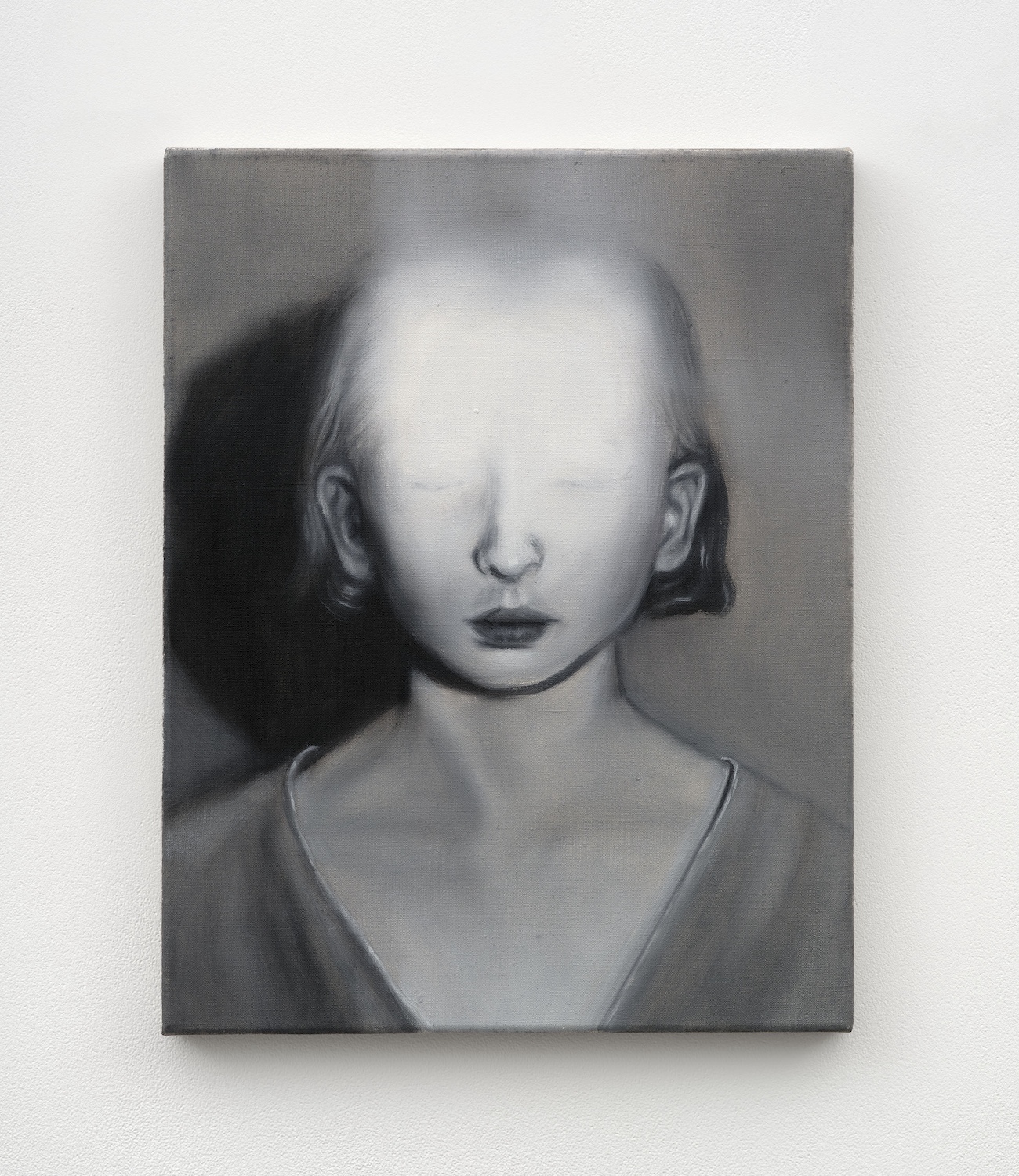
Mia Middleton, “First Girl,” 2026. (Photo: Paul Salveson, courtesy of the artist and Roberts Projects, Los Angeles)
Many of the paintings focus on fragments, such as a covered face, crossed legs, an arched foot, or a figure seen from behind. What interests you about showing only part of a person or action rather than revealing the entire scene?
I think I’m a very fragmented person! Or maybe a better way of saying it is I believe in plurality of self, I try not to tell myself one story about who I am, I try to keep myself as open as the abstractions inherent in everything, it lends me a kind of generative joy that I think I'd sorely miss otherwise. By intentionally limiting disclosure in my works I try to create from that same place and expand the mystery of the scenes and figures. It’s alluring to reduce figures to semiotics in a sense, so that each form becomes a costume any viewer can inhabit, or feel silently watched by. Either way we become engaged with and answerable to these forms.
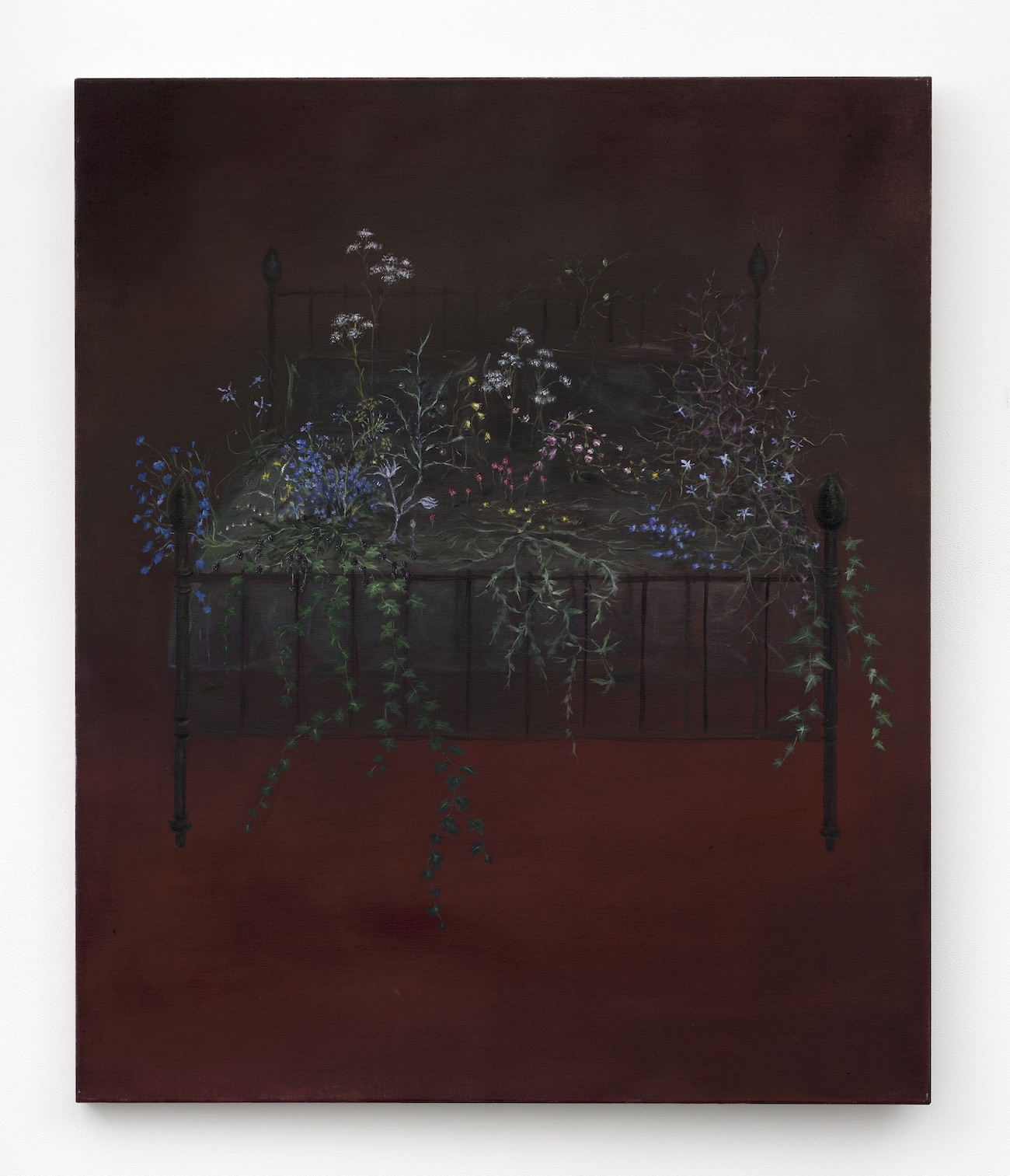
Mia Middleton, “Laeba Bríde (Brigid’s Bed),” 2026. (Photo: Paul Salveson, courtesy of the artist and Roberts Projects, Los Angeles)
This exhibition includes both very intimate paintings and works made at a much larger scale. How did working bigger change the way you thought about the figures, gestures, and spaces within these paintings?
It has been a really fascinating process for me, and I’m just getting started really. I’m glad I didn’t rush myself here, because it appears to be unfolding naturally now. I’ll always love small works, and they will continue to be an important part of my practice, and in fact the challenge for me is how do I preserve the “glimpse” at a larger, more open scale? It felt limiting to simply scale up images I’d paint small, but disingenuous to start to create more expository tableaus. So I’m leaning into the content doing what the framing does at a smaller scale. For example, in the painting Citadel an entire location is depicted but it is inherently impenetrable. Or in Interval, only the concealment is depicted. So it’s a fun new exercise. With figuration, it affords me the freedom to flesh out my “characters” and preserve their anonymity in new ways. It’s a breath of fresh air for me now that I’m ready and hungry for it. I’m also loving the full-body approach of larger works and the connection to the fluidity of paint and color. At a smaller scale, painting is so tight and meticulous. At larger scales the medium really opens up and reveals itself.
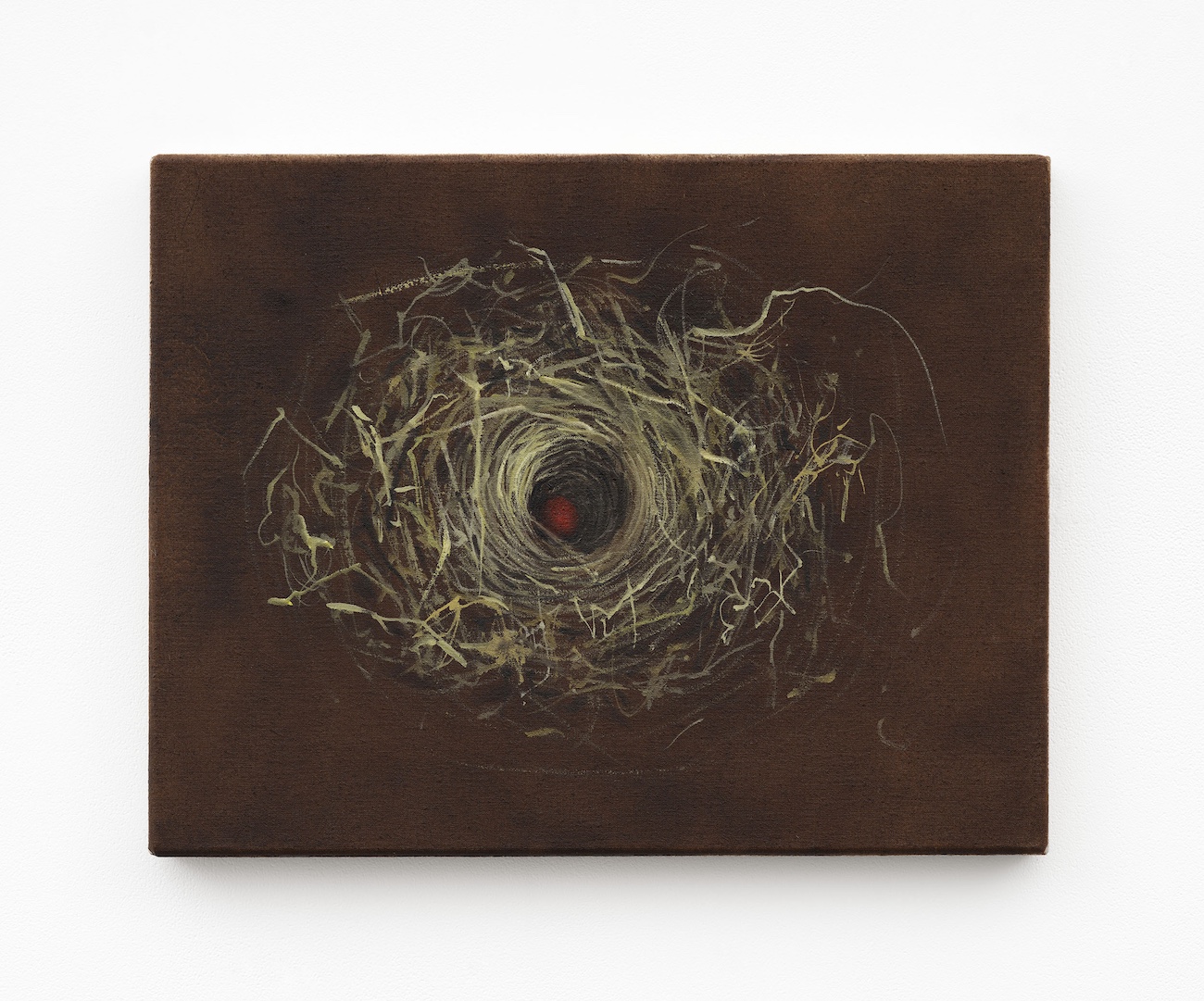
Mia Middleton, “The Shape of Red,” 2026. (Photo: Paul Salveson, courtesy of the artist and Roberts Projects, Los Angeles)
Cleo is described as being at the center of the exhibition, even though she never actually appears. Who or what is Cleo to you, and why was it important for her presence to be felt rather than directly represented?
Cleo to me is my fantasy of a certain future. That figment that you pin your hopes and dreams on, the thing you think will orient you in a way nothing else has. It was important to keep her hidden or unreachable because life is so full of these necessary illusions; we idealise one version of the future knowing full well it won’t be all roses, if it arrives at all. Crucially, we have to believe these figments though, they push us forward through the mud and mire of society. The fantasy is essential in its simplification or absurdity, and it is the raw materials of faith and belief. For me, this show is about finding my own creeds and beliefs beyond the academic or conceptual interests that usually ground me. Throwing out logic and reason, and trusting the mystery, doubling down on rituals and practices that summon fortitude and faith even in the darkest corners of life, in the knowledge that the future is never what it might seem.
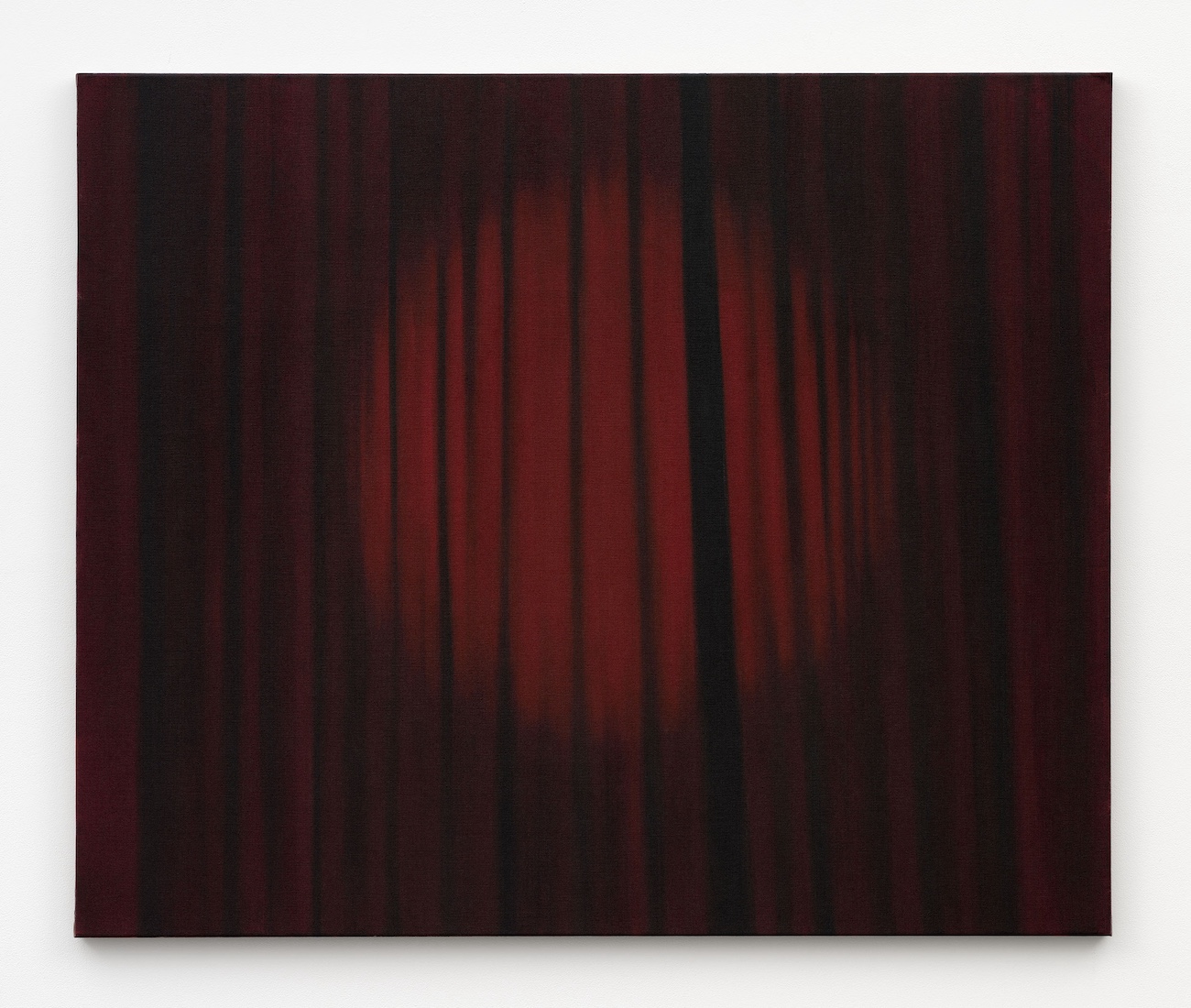
Mia Middleton, “The Interval,” 2026. (Photo: Paul Salveson, courtesy of the artist and Roberts Projects, Los Angeles)
Your paintings seem to deliberately resist giving viewers a complete story. What do you hope happens when someone spends time with an image but never receives a clear answer about what is taking place?
I think people either find my practice alluring or withholding, and whatever side of that divide a person sits on says more about themselves than it does about anything else. How willing are you to take the bait and imagine, extrapolate, or accept uncertainty? It’s a question I am asking myself every day and am asking the viewers too.
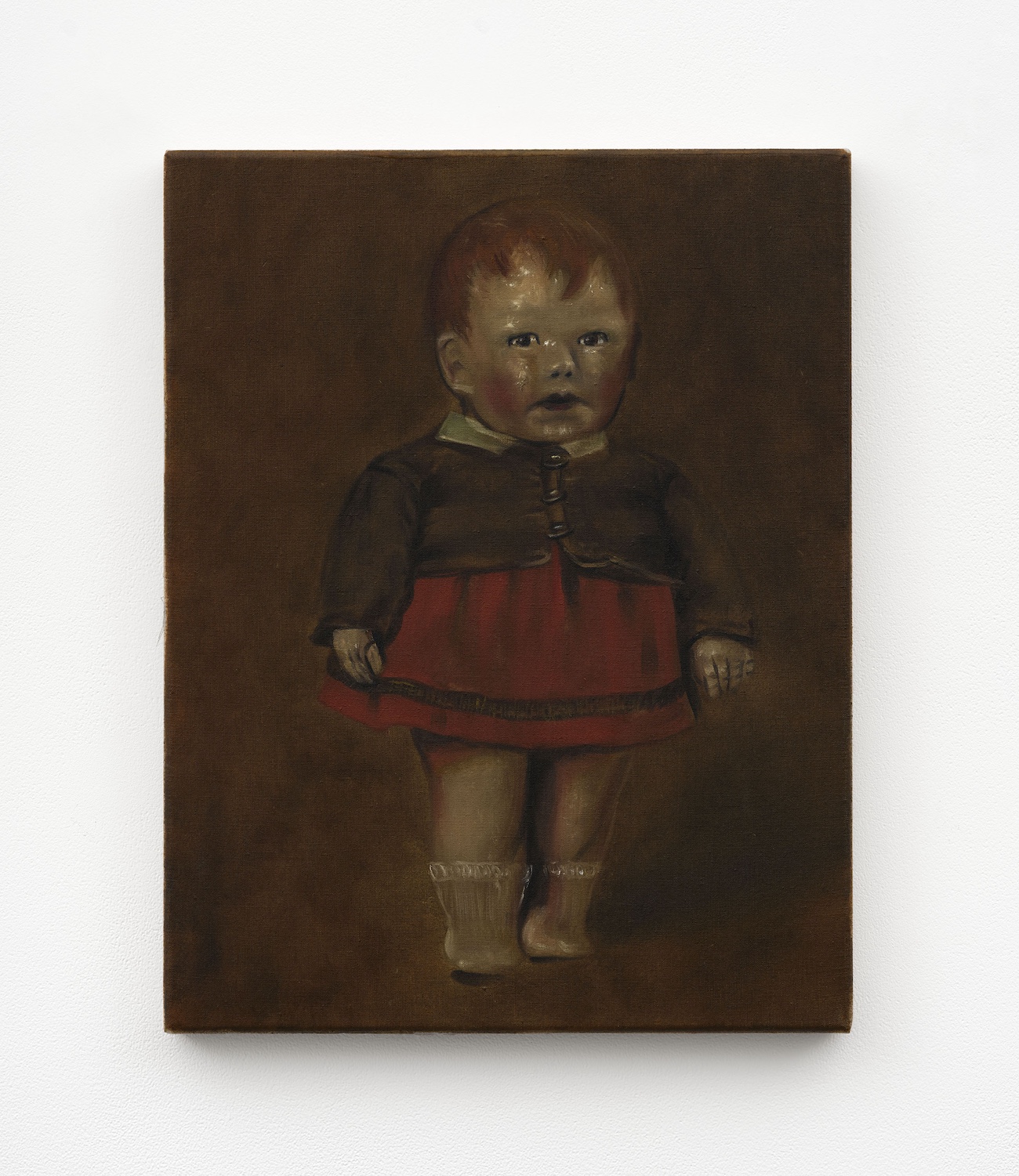
Mia Middleton, “Cherub (Puppenkind),” 2026. (Photo: Paul Salveson, courtesy of the artist and Roberts Projects, Los Angeles)