
Neuroscientists still debate the precise origins of dementia. Decades of research confirm one fact, though: several risk factors respond directly to lifestyle choices. A new study in Neurology Open Access strengthens this argument. It also pinpoints an exact window when three specific health measures carry outsized weight for long-term brain health. It turns out that between ages 45 and 65 are key years.
Researchers from institutions across the U.S. and China analyzed health records from 12,409 participants. The team followed these participants for a median of 26 years. They tracked three modifiable vascular risk factors: high blood pressure, diabetes, and smoking. Participants who avoided all three conditions during midlife gained nearly 13 additional dementia-free years on average.
The findings single out vascular health as a unifying mechanism. Blood pressure, diabetes, and smoking each damage blood vessels over time. This shared pathway may explain why the three factors compound one another so significantly. “Maintaining optimal midlife vascular health was associated with up to 12.6 additional dementia-free survival years, reflecting both higher dementia hazard and markedly higher competing mortality,” the study concludes. They frame this time-based measurement as a practical clinical tool. A countdown of preserved years communicates risk more vividly than a percentage ever could.
The data also surfaced meaningful differences across demographic groups. The researchers controlled for sex, race, age, physical activity, and the APOE4 gene, a well-documented genetic contributor to Alzheimer’s risk.
Women who carried all three risk factors retained dementia-free health for an average of 18.1 years from the start of the study. Men averaged 16.6 years. Racial disparities emerged as well. White participants averaged 19.6 dementia-free years, while Black participants averaged 16 years. This gap reflects documented, systemic inequities in cardiovascular care access.
“These results suggest that vascular risk reduction may benefit all groups, but that certain populations, such as Black adults, may especially benefit from targeted prevention efforts,” says epidemiologist Josef Coresh of NYU Langone Health, one of the study’s authors. Coresh notes that the stakes extend well beyond cognitive decline alone. Participants who carried all three risk factors also faced a heightened likelihood of earlier death overall.
The study cannot establish direct causation. Observational data of this kind can only demonstrate association, not mechanism. Even so, the size of the dataset and the length of the follow-up period lend the findings considerable weight. Coresh puts the broader stakes plainly: “Discovering new ways to delay dementia is crucial with 42% of Americans at risk for developing the condition at any time after age 55.”
The research team hopes clinicians will use this framing to encourage earlier intervention. Quitting smoking, managing blood glucose, and controlling blood pressure all qualify as achievable midlife changes. Future research will likely examine how directly modifying these factors shifts long-term dementia outcomes.
The global population continues to age. Researchers increasingly investigate not just whether dementia develops, but when it develops. This time-based framework may soon become a standard tool for both prevention and public health messaging.
A decades-long study of more than 12,000 people found that avoiding three vascular risk factors, high blood pressure, diabetes, and smoking, between ages 45 and 65 was linked to nearly 13 additional dementia-free years.
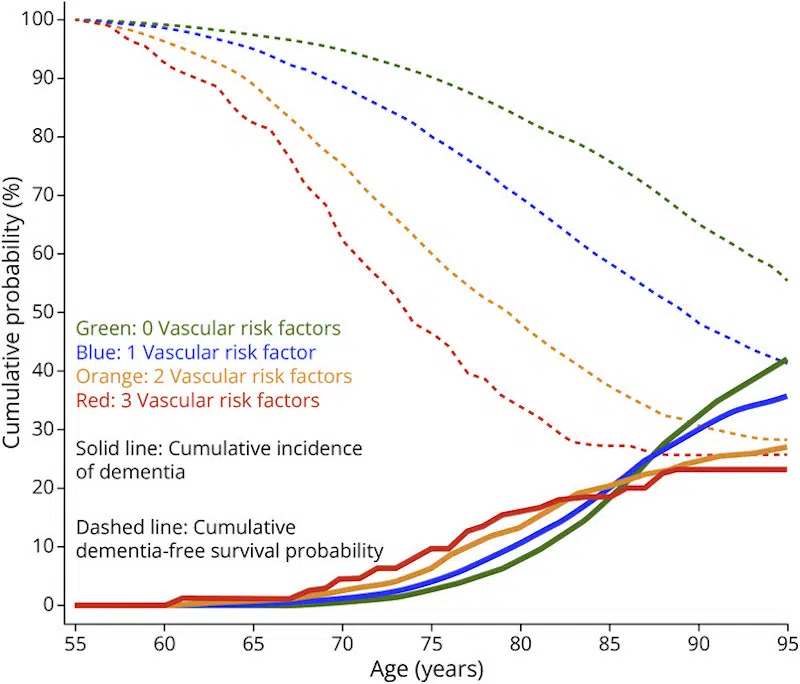
Cumulative Incidence of Dementia and Dementia-Free Survival Probability From Age 55 to 95, by Number of Midlife Vascular Risk Factors (Photo: Hu et al., Neurol. Open Access, 2026)
The findings highlight how everyday health decisions can shape cognitive aging and may offer a practical path toward dementia prevention.

Sources: Midlife Vascular Risk Burden and Dementia-Free Survival Years; What You Do Between 45 And 65 Could Buy You 13 Extra Dementia-Free Years, Study Finds
Related Articles:
New Studies Suggest That Birdwatching Will Help Boost Your Brain Health
New Study Reveals the “Sweet Spot” of Steps You Need To Take Every Day To Stay Healthy
Study Finds That Dancing Helps With Weight Loss and Also Improves Physical and Mental Health