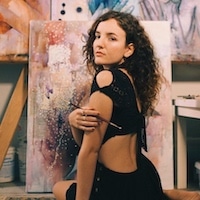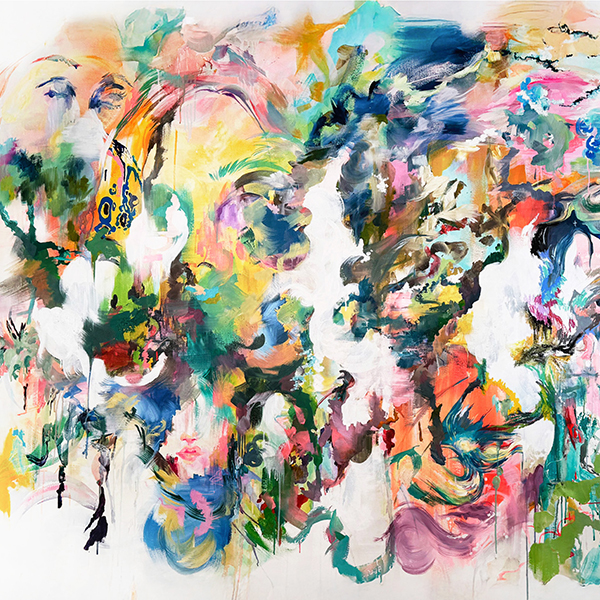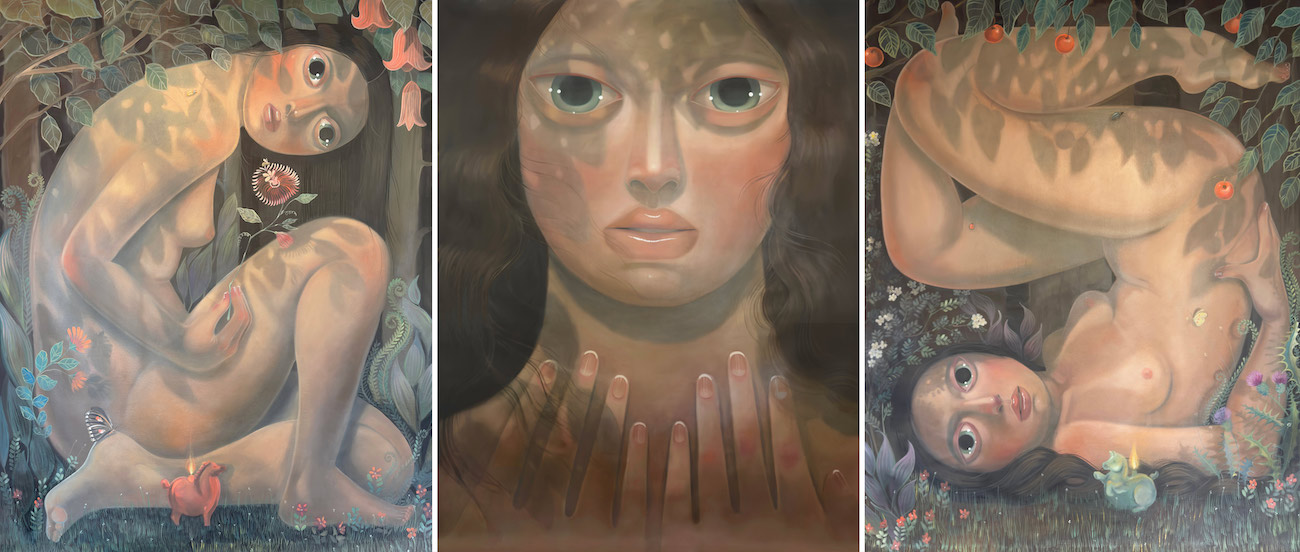
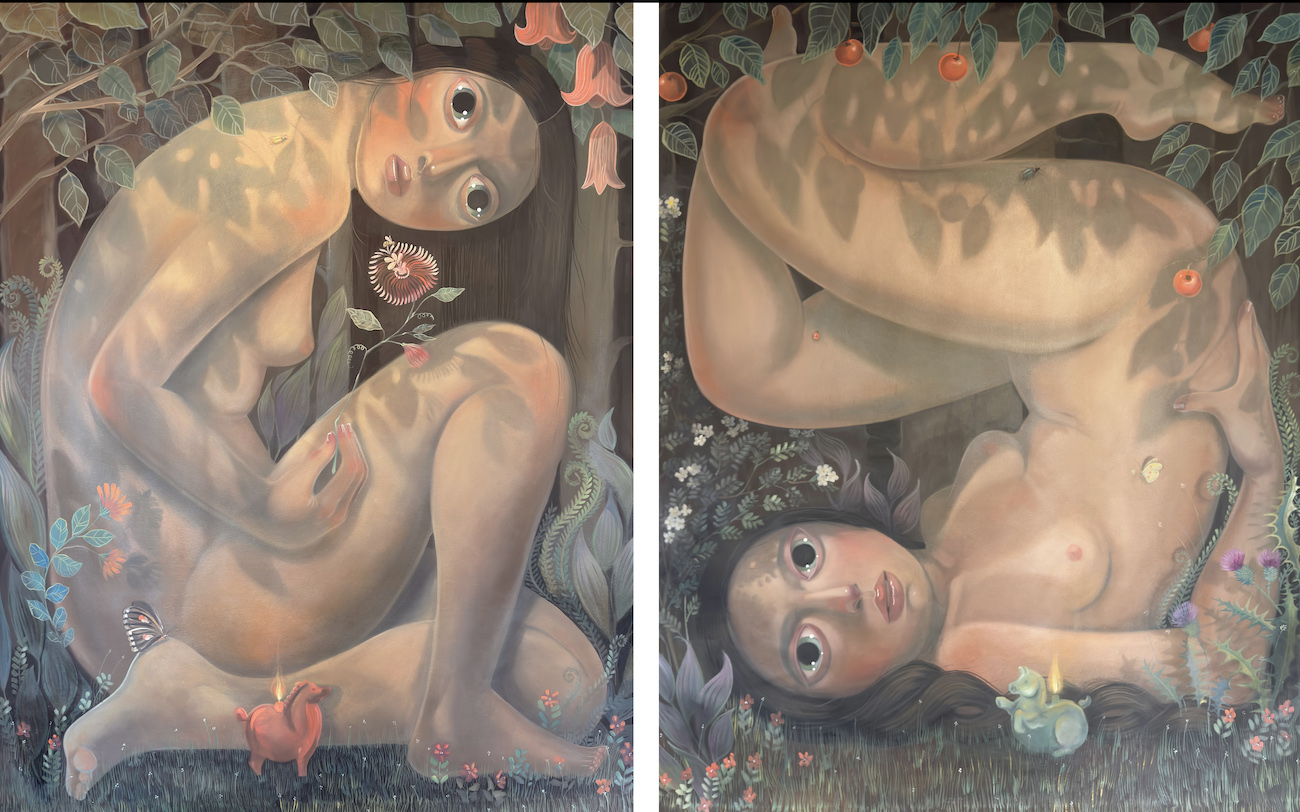
Three women stare directly at the viewer from within a wild, tangled landscape. Their bodies fold and intertwine across Trying to Transcend in the Midst of Everything, a monumental triptych by Tania Marmolejo.
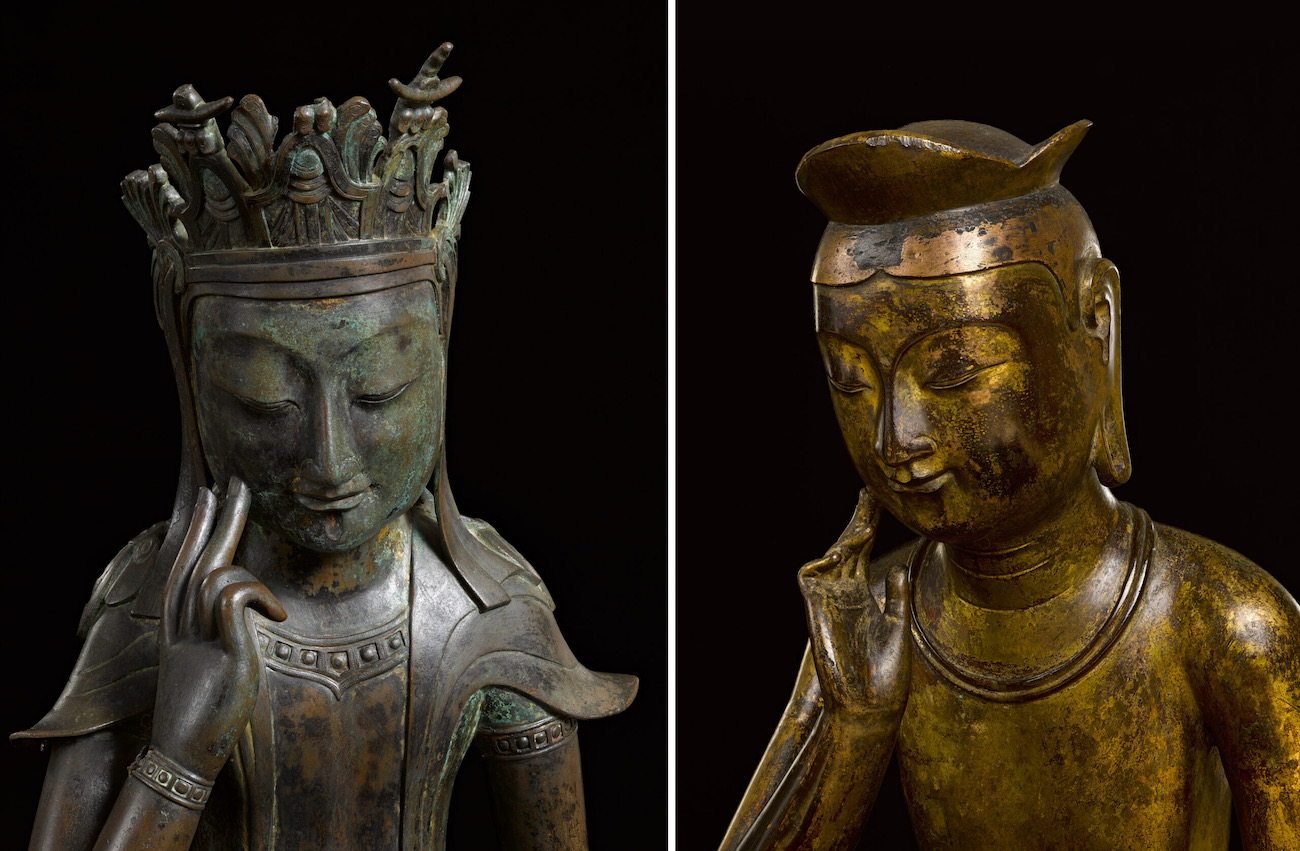
Created for ELIGERE Gallery’s presentation at Kiaf SEOUL 2026, the work responds to two gilt-bronze Pensive Bodhisattvas at the National Museum of Korea. Marmolejo was drawn to their quiet gestures and inward expressions, which convey a movement from human anguish toward enlightenment.
Rather than recreate the sculptures, Marmolejo translates their contemplative state into contemporary figurative painting. The outer panels echo the Taijitu, or yin-yang symbol, through their opposing forms and poses. At the center, another figure meets the viewer’s gaze, shifting the focus from inward reflection to emotional confrontation.
The triptych continues Marmolejo’s exploration of duality. Her women often exist between vulnerability and determination, desire and hesitation, or retreat and confrontation. Their enormous eyes intensify this uncertainty, leaving the viewer to determine what each figure might be feeling.
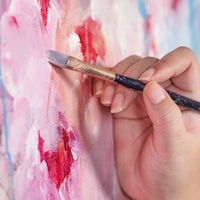
Marmolejo combines her background in animation with the layered techniques of Renaissance, Baroque, and Flemish painting. Yet her process is largely intuitive. Expressions begin with spontaneous brushstrokes, while color, landscape, and narrative details emerge as she works.
My Modern Met had the opportunity to speak with Marmolejo about the Pensive Bodhisattvas, her signature gaze, and the intuitive process behind her monumental paintings. Scroll down to read our exclusive interview.
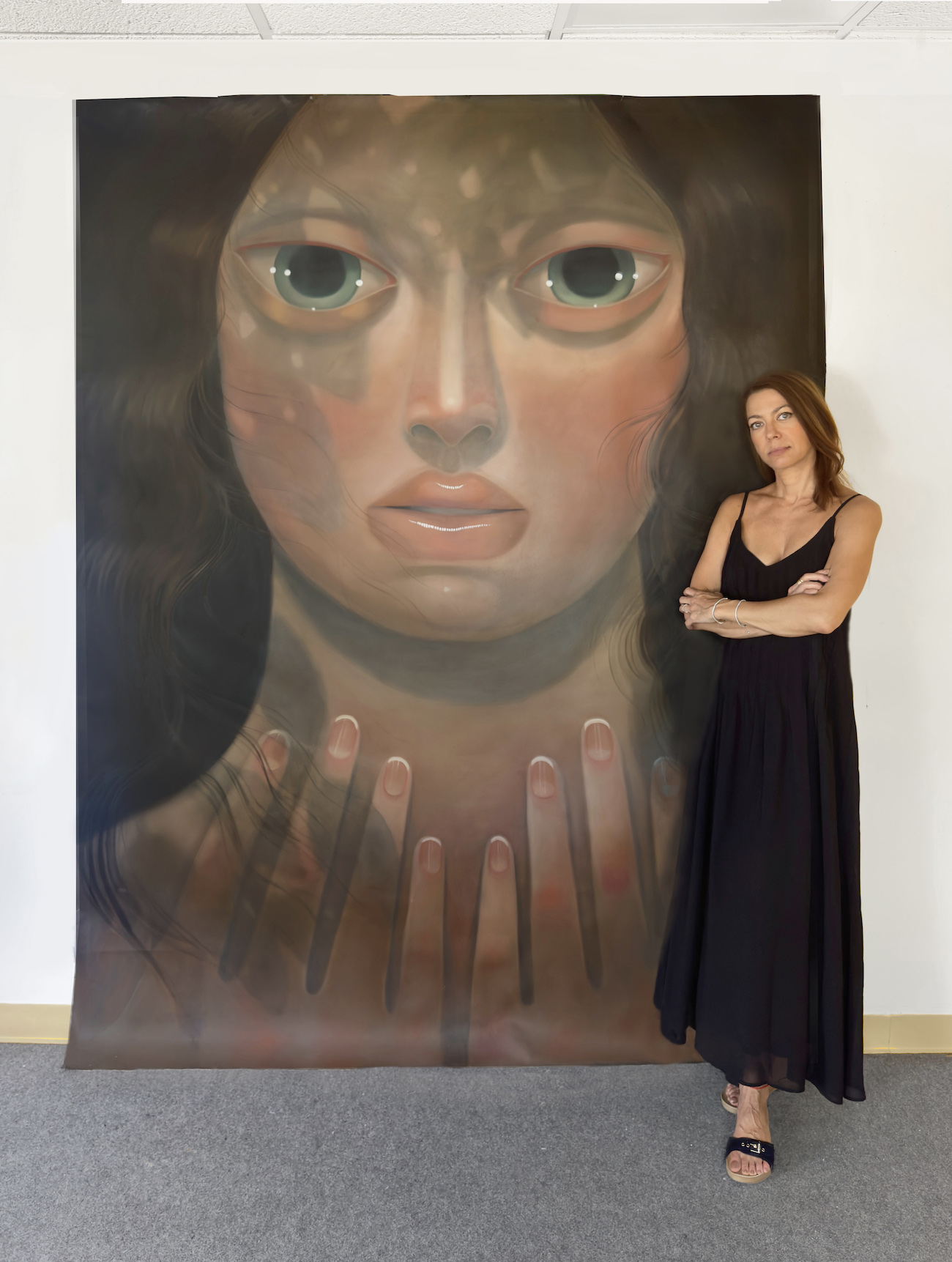
Can you take us through the making of one of your large-scale paintings, from the first sketch or idea to the layers of paint and the decisions you make along the way?
I will use my triptych, Trying To Transcend in the Midst Of Everything—a large- scale set of paintings currently on view at Eligere Gallery in Seoul—as an example of my creative process.
The inspiration for this large-scale work struck unexpectedly after I viewed photographs of the two gilt-bronze Pensive Bodhisattvas at the National Museum of Korea. Feeling a profound connection to the statues, I initially wanted to recreate them in my own style, but ultimately chose to paint the emotion they evoked instead: a deep yearning for transcendence.
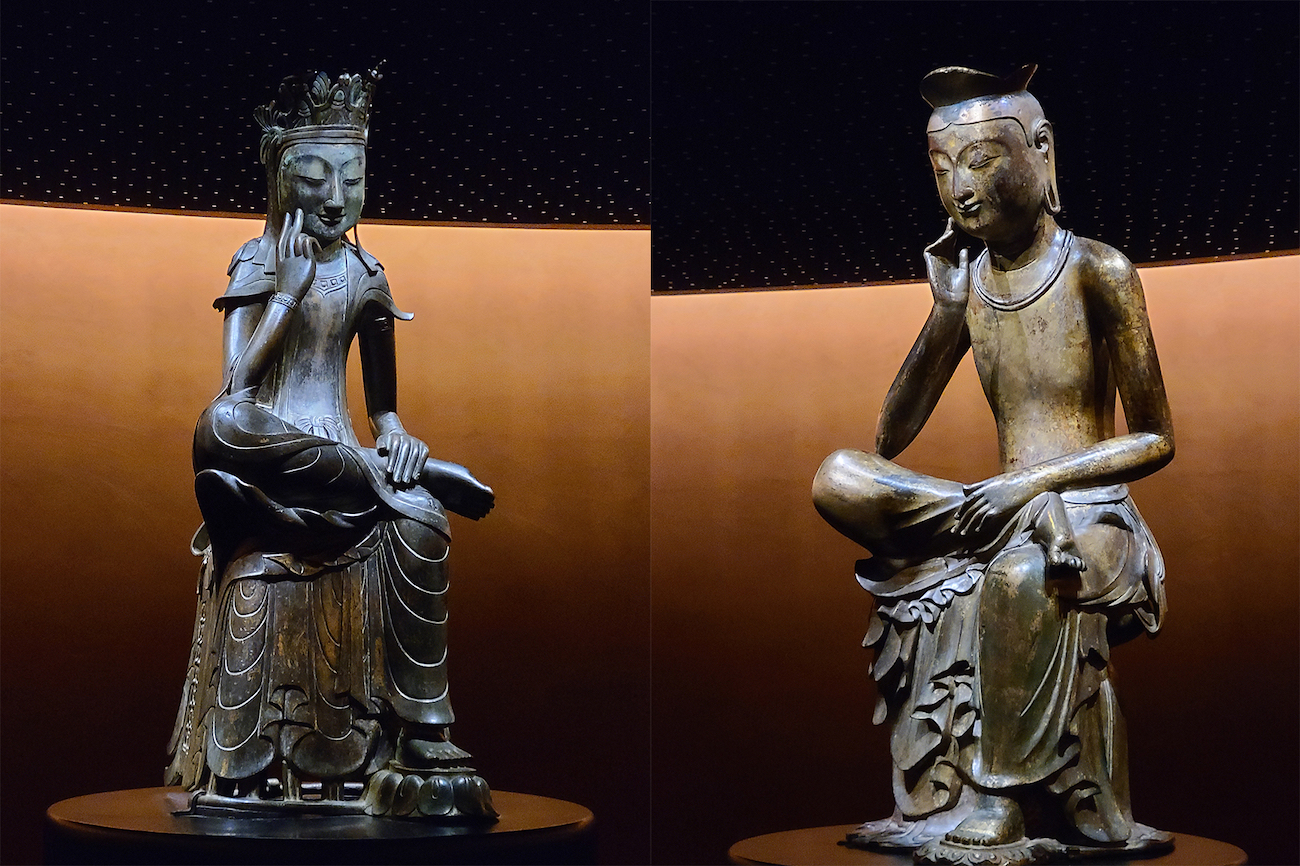
(continued) This concept evolved into an exploration of our own struggles with meditation, clarity, and the opposing forces of duality. To capture this tension, I incorporated a subtle Taijitu (yin-yang) symbol and set the female figures—whom I envision as “Eve” in her Garden of Eden—within a wild forest, symbolizing our closest link to nature and our wild, untamed selves.
My process is deeply intuitive; I rarely sketch or plan beforehand. Instead, I allow thoughts, feelings, and fine details—like flowers and insects—to emerge spontaneously on the canvas, only seeking visual references as needed. To complete the narrative, I introduced a central third piece: a close-up of a large face that physically interrupts the Taijitu, mirroring our interrupted pursuit of mental clarity.
Your figures have enormous eyes and giant pupils that resist being read, so how did that signature feature develop, and how do you paint eyes that hold the viewer’s gaze without giving anything away?
I had been a character designer for animation in the beginning of my career. The manga style was influential at the time, and I developed my own style that reflected this in my designs.
The intense expressions of the characters became a defining, recurring theme in my work, that later carried over into my personal paintings.
Viewers often note that it feels as though the figures are looking directly at them, and quite intensely. This happens very spontaneously—I paint the gaze, following a feeling, and finish the painting from there. I can’t quite explain how it happens. The gaze is usually somewhat ambiguous, as I’d like the viewer to identify with the feeling as their own.
The cartoonish qualities in your work come from years of designing characters for animation, so how do you blend that graphic, stylized language with the layered, painterly techniques of the Old Masters and Expressionists?
I have always been a huge fan of the Old Masters, the Renaissance, Baroque, and Flemish artists, and the way they layered paint and created luminous works. I am a self-taught artist, and for most of my young life I tried to copy their styles when painting, while also developing a cartoonish “doodling” when drawing that became a signature style. It wasn’t until I went to art school and refined my techniques that I felt I could combine the two styles and create my own as I tried to turn the drawings into paintings. The Expressionists were also an influence, as my art became more about creating feeling and emotion in the work than following a particular style. It all happened very organically.
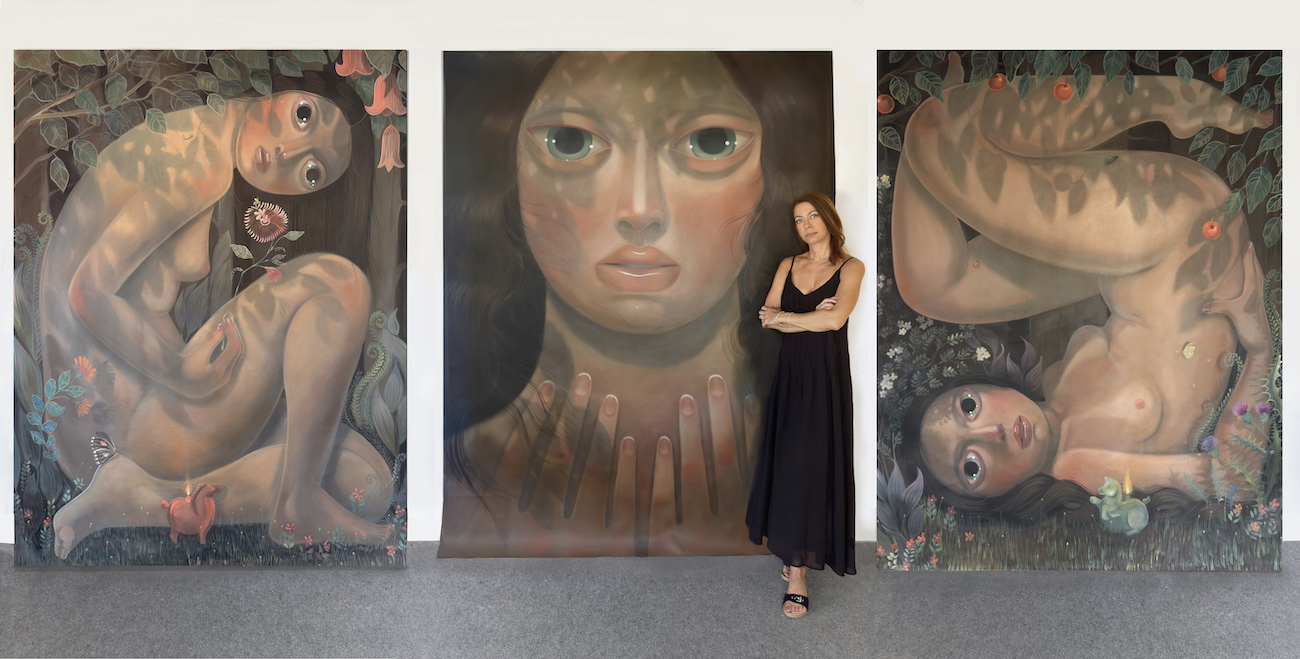
When you work at monumental scale, how does it change the way you physically paint, and what happens to a face or a gesture once it's larger than the person looking at it?
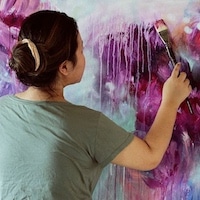
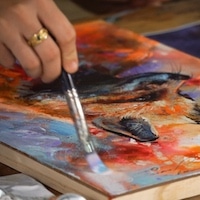
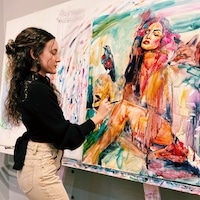
I love painting on a monumental scale; it transforms the process into a deeply visceral, physical act. My entire body is in motion; I almost dance across the canvas as I apply brushstrokes. Every facial feature—the eyes, nose, and mouth—begins as an intuitive, sweeping gesture. This is my favorite part of the process, a moment where I enter an almost trance-like state.
Once I begin refining the features and adding detail, I have to step back and sometimes photograph the painting so I can see the full image objectively, and make sure the gaze is intimate. That in itself is a push-pull process!
In some of your paintings, the landscapes seem to reflect the figures’ inner worlds, so how do you decide what grows, blooms, or presses in around each woman?
The landscapes are very much an expression of what is happening inside the figure, a reflection of the strong emotions that I usually depict—and an indication of a push-pull, a duality in emotions that not always is obvious in the figure’s expression. Sometimes the landscape can represent outside forces that interact with the figure, oftentimes creating tension. They are as important as the figures themselves and offer clues to the meaning of the painting. Usually the landscape and the details around the figure are created after the initial expression, and as I paint I decide what is happening to her, what I want to tell the viewer. They are usually spontaneous decisions.
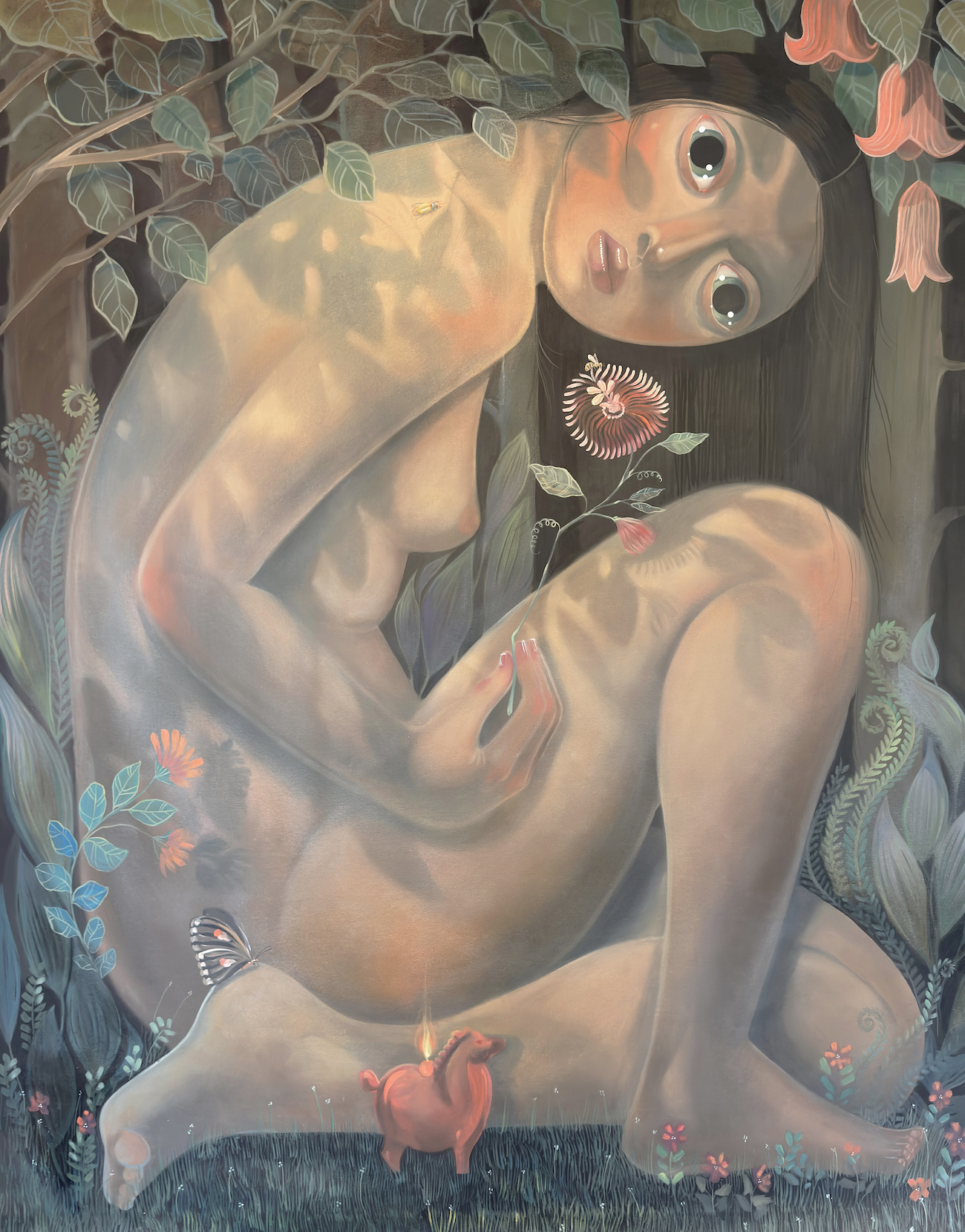
“Trying To Transcend In The Midst Of Everything,” oil on canvas, 90 x 70 inches, 2026.
Can you describe the palette, the textures, and the rhythm of your process, and how you know when a painting has found the right balance between tension and calm?
The most difficult part of painting for me is exactly that—achieving a balance. In my case, my signature is the balance between tension and calm as you have mentioned—between opposing forces. That is the most important aspect, and it usually starts with spontaneous gesture brushstrokes of the facial expressions. Once I feel I have an expression that starts to reflect that tension, I then choose the palette according to what I feel the character is going through.
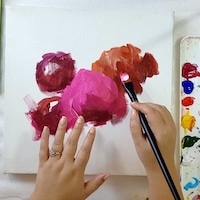
I basically decide as I paint. So I don’t have pre-set color palettes, I choose a color I feel expresses something I see in the character, and from there I pick the complementary colors and design around that. But sometimes I see a color palette that I like in a photograph, and that helps guide the feeling of the painting when I paint the gestures of the expression. So it can begin with color or end with color. Since color is in itself a mood, it definitely helps set the tone wether it is in the beginning or the end of the process. Because of this fact I tend to layer the paint, painting in transparencies until I reach a desired balance.
The whole process is very expressionistic even though it may not look like it. This usually is what surprises people the most, that it is such a spontaneous and organic process.
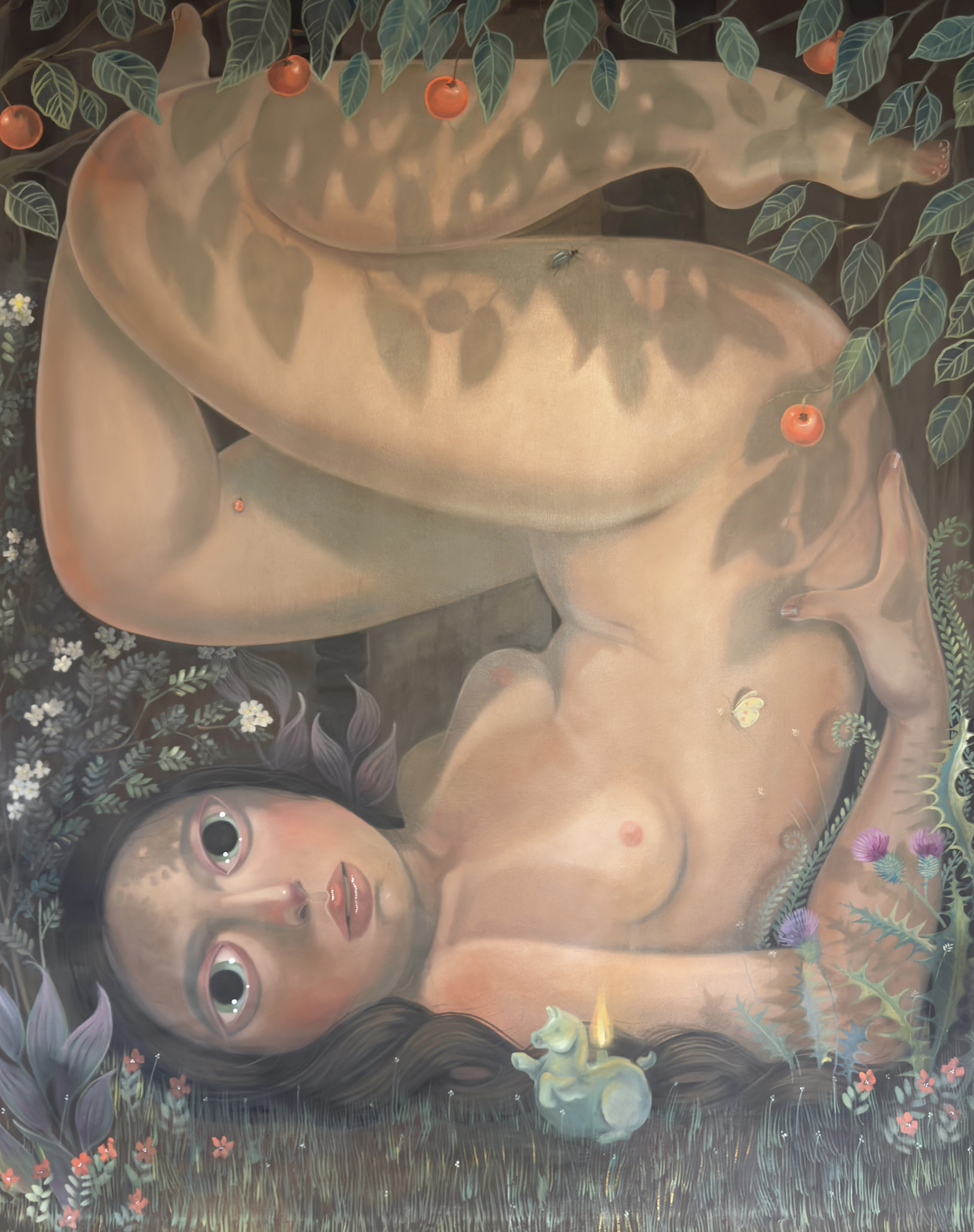
“Trying To Transcend In The Midst Of Everything 2,” oil on canvas, 90 x 70 inches, 2026.
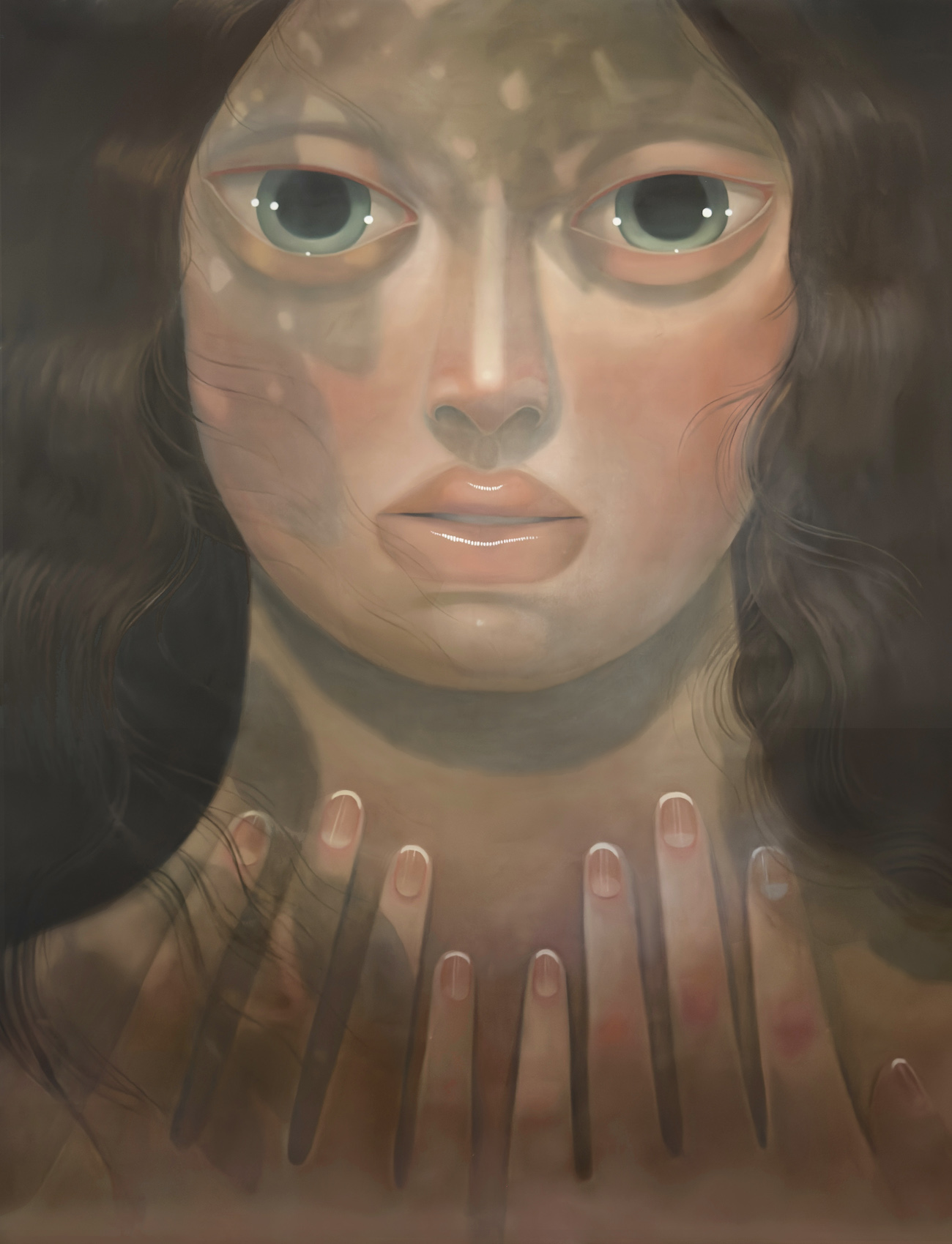
“Trying To Transcend In The Midst Of Everything 3,” oil on canvas, 90 x 70 inches, 2026.
View this post on Instagram