Embed from Getty Images
Deep in the storerooms of France’s National Library in Paris, curators uncovered a small 44-page notebook that would soon reshape part of Wolfgang Amadeus Mozart’s early history. The manuscript, written in 1778 when Mozart was 22 and working in Paris as a music teacher, sat unidentified for more than 230 years, miscatalogued among centuries of archival material. Its rediscovery came in February 2026, when musicologist François-Pierre Goy spotted familiar handwriting while reviewing anonymous scores.
Goy, who works in the Bibliothèque nationale de France’s (BnF) Music Department, had recently studied verified Mozart teaching documents, which helped him recognize the composer’s distinctive notation in the treble and bass clefs. He brought the manuscript to colleague Laurence Decobert, and together they compared it to known Mozart sources. Their findings were later confirmed in April 2026 by Armin Brinzing of the Mozarteum Foundation in Salzburg, officially identifying the notebook as Mozart’s work.
The notebook traces back to Mozart’s time in Paris, where he taught Marie-Louise-Philippine de Guînes, a young harpist from a prominent aristocratic family. Her father, the Duke of Guînes, a skilled flutist and commissioner of Mozart’s Concerto for Flute and Harp, formed part of the same musical circle reflected in the manuscript. Inside, researchers found daily teaching exercises alongside seven pieces for flute and harp, likely intended for performances between father and daughter.
The pages reveal Mozart not as the celebrated composer of grand symphonies, but as a working teacher shaping lessons in real time. He composed exercises for his student, refined ideas in response to her needs, and built music around the intimate setting of private instruction. The result offers a rare glimpse into his daily creative process during a pivotal moment in his Paris years.
The notebook’s survival adds another layer to its significance. During the French Revolution in 1794, authorities confiscated the Duke of Guînes’ music collection, which later entered France’s national archives. Over time, the manuscript faded into obscurity, where it remained unnoticed for centuries.
After centuries of silence, the music finally returned to life. On June 21, 2026, performers premiered the rediscovered pieces at the BnF’s Richelieu site during Paris’ Fête de la Musique. The performance transformed a long-forgotten teaching notebook into living sound once again, reconnecting modern audiences with Mozart’s world as it was first being written.
A forgotten notebook has been identified in the archives of France’s National Library, revealing music written by 22-year-old Mozart during his time in Paris in 1778.
Inside, scholars found daily teaching exercises and early flute and harp pieces created for a young aristocratic student and her family.
After more than 230 years in storage, the manuscript resurfaced and was recently brought to life in a public premiere at the BnF in Paris.
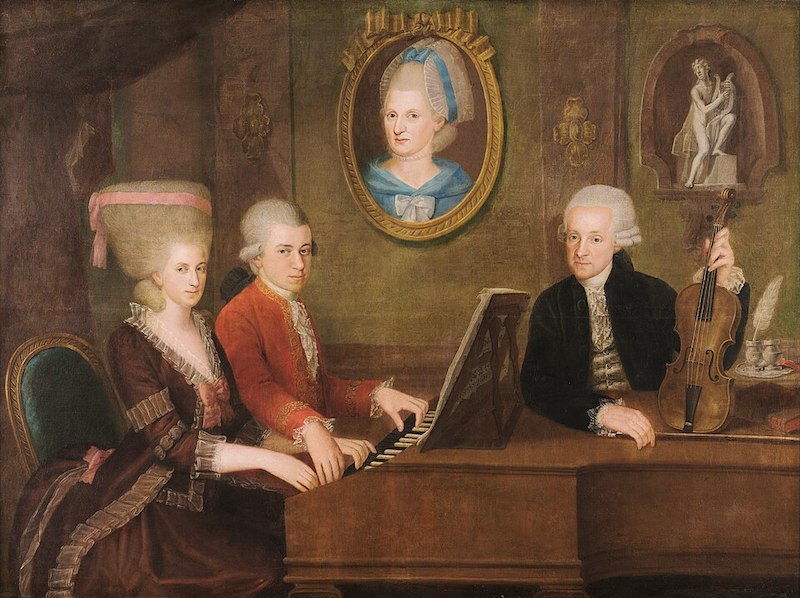
This portrait shows the Mozart family, the mother passed away earlier but is shown in a portrait within the painting. The painting underlines the importance of music within the family. (Photo: Johann Nepomuk della Croce via Wikimedia Commons, Public domain)
Sources: 22-year-old Mozart’s handwritten notebook unearthed in ‘major discovery’; Major Mozart Discovery: Lost Notebook of 22-Year-Old Composer Unearthed in Paris
Related Articles:
When Mozart Was a Teen, He Pirated a Secret Song From the Sistine Chapel
5-Year-Old Italian Piano Prodigy Wows Crowd With Amazing Mozart Rendition
Researchers Discover Previously Unknown Music Mozart Composed as a Teenager
What Mozart’s Music Actually Sounds Like When Played on His Original Pianoforte